
| Rank | Player | Years |
| 1 | Adam Vinatieri | 1996-2019 |
| 2 | Morten Andersen | 1982-2007 |
| 3 | Justin Tucker | 2012-2024 |
| 4 | Stephen Gostowski | 2006-2020 |
| 5 | Jan Stenerud | 1967-1985 |
| 6 | Matt Prater | 2007-active |
| 7 | Sebastian Janikowski | 2000-2018 |
| 8 | David Akers | 1998-2013 |
| 9 | Harrison Butker | 2017-active |
| 10 | Gary Anderson | 1982-2004 |
Why is Robert Lewandowski historically significant?
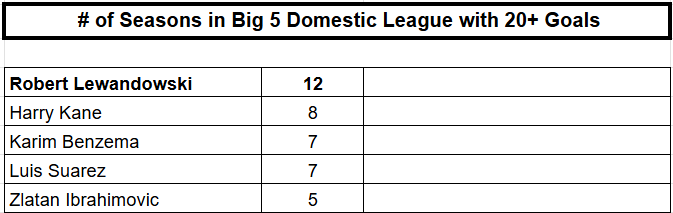
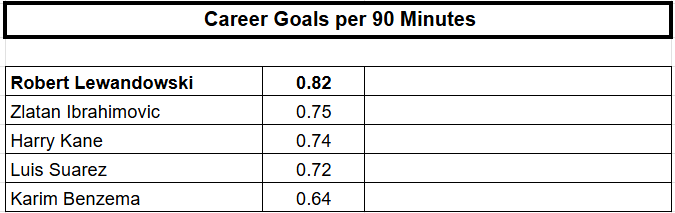
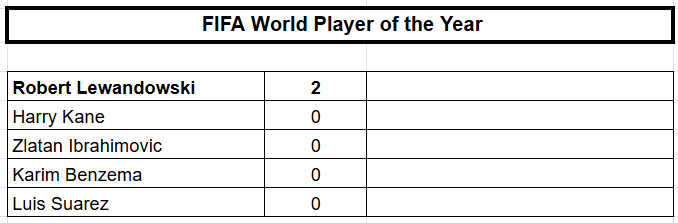
There seems to be some disconnect regarding whether Robert Lewandowski has been one of the top players of his generation, which is staggering considering the evidence is everywhere. Being mesmerized by Messi and Ronaldo can do that to people. Let’s get the notion of Lewandowski’s relevance out of the way now: He is one of only five players in history to win both the FIFA World Player of the Year and World Soccer magazine’s World Player of the Year twice each. The others are Lionel Messi, Cristiano Ronaldo (CR7), Ronaldinho, and Ronaldo (R9). Where anyone chooses to rate Lewandowski comes down to personal choice, of course, but there is no doubt that he is one of the most accomplished soccer players in the history of the sport.
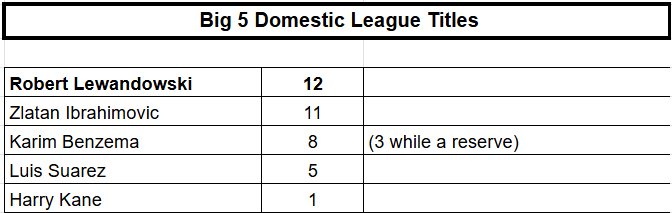
There should be little question that Messi and Ronaldo are the two greatest footballers of all-time. Their accomplishments are in a different stratosphere than anyone who has ever played the game considering their competition level. Pele, of course, was a word-class player who was the long serving GOAT following his legendary exploits on the pitch in–and for–Brazil, but it’s difficult to compare Pele and the other great players of his era like Eusebio, Garrincha, and Alfredo Di Stefano to the juggernauts that are Messi and Ronaldo. Domestic league competition in the mid-20th century was considerably more diluted than what we see today. Pele did his cooking in a Brazilian state league, which is similar to LeBron James playing all of his games in the Mid-American Conference (MAC). While Pele’s star has been surpassed by the two mega-stars of this era, the player who joins Pele as Messi and Ronaldo’s closest galactic neighbor is Robert Lewandowski. There’s no question that Lewy is a known commodity in the soccer world, but his resume is much, much more historically significant than most realize. In fact, when it comes to doing things that had previously never been done before in a Big 5 domestic league, he’s the closest to Messi and Ronaldo that we have ever seen.
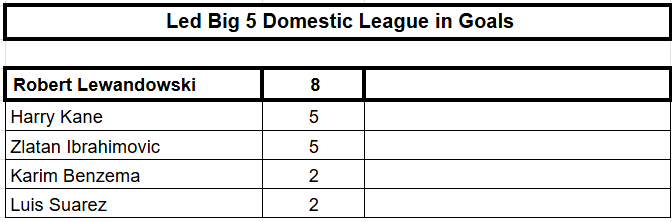
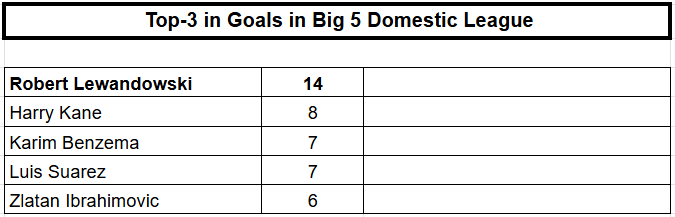
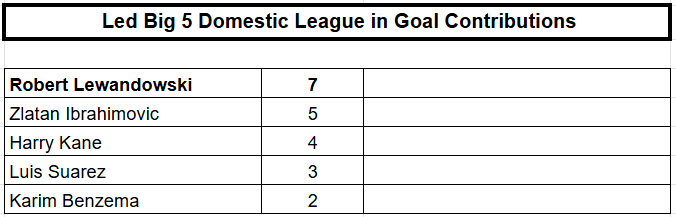
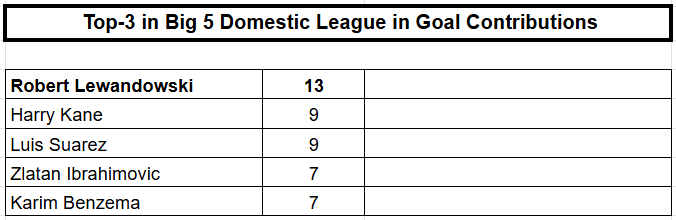
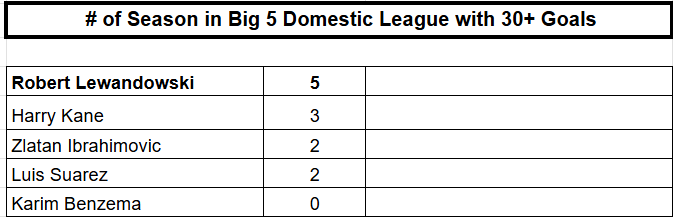
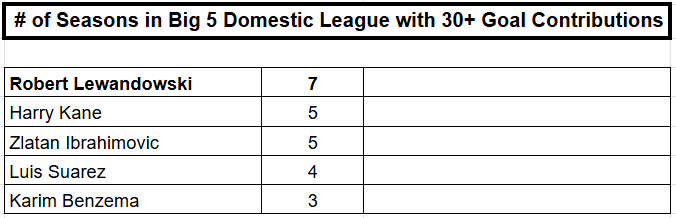
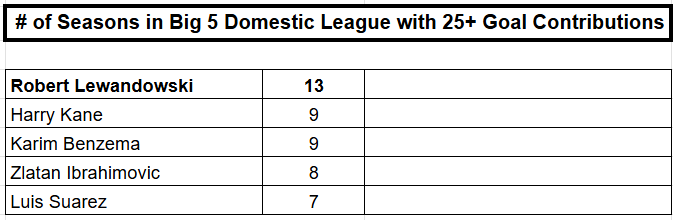
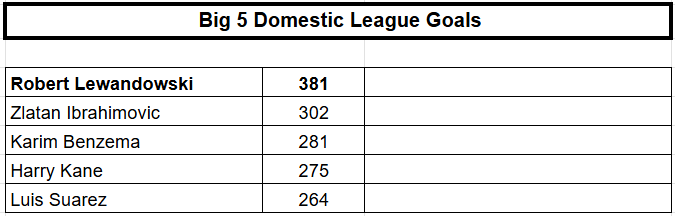
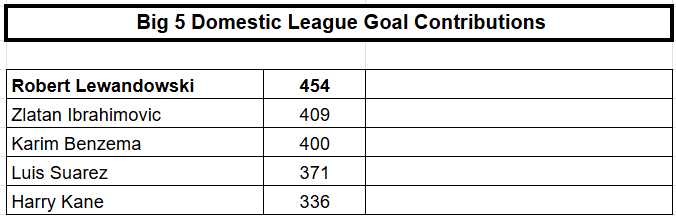
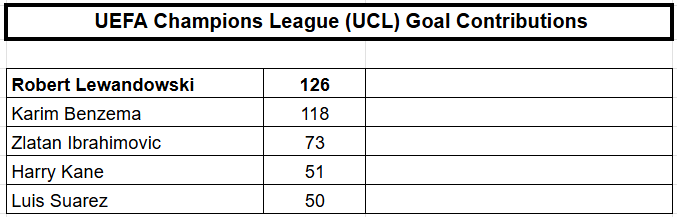
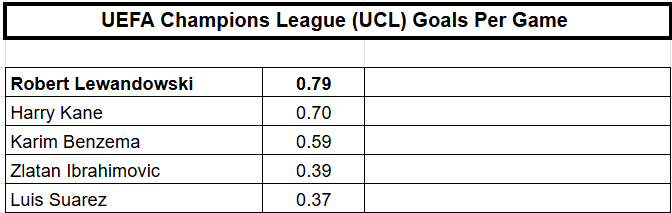
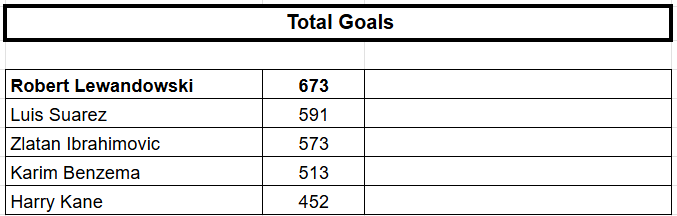
The argument for Lewandowski is as easy as they come. He’s one of only four players in history to win the FIFA Player of the Year award in consecutive years. The others? Messi, Cristiano Ronaldo, and Ronaldo. He has led a Big 5 domestic league in goals a record eight times. Not even the great Cristiano Ronaldo can say the same. He scored at least 10 goals in four different UEFA Champions League seasons (UCL). Only Messi and Ronaldo have duplicated that feat. He scored 41 goals for Bayern in 2020-2021. Only Messi and Ronaldo scored more in a single Big 5 domestic league season. He scored 15 goals in the 2019-2020 UCL season. Only Ronaldo scored more in a UCL season. He scored at least 13 goals on two different occasions in the UCL. Only Ronaldo did it more often. Lewandowski has 105 career UCL goals. Only Messi and Ronaldo scored more. Lewandowski’s UCL goals per game ratio stands at .79. Among players with at least 50 UCL goals, only Messi has a better ratio. Lewandowski has 381 (and counting) Big 5 domestic league goals. Only Ronaldo and Messi have more. Lewandowski has 13 Big 5 domestic league seasons with at least 27 goal contributions (goals + assists) and 11 Big 5 domestic league seasons with at least 29 goal contributions. Only Messi and Ronaldo have more. He has five Big 5 domestic league seasons with at least 30 goals. Only Messi and Ronaldo have more. Lewandowski scored a hat trick in the UCL for three different clubs. Nobody has ever equaled that feat and it’s possible nobody ever will. Lewy has six UCL hat tricks. Only Messi and Ronaldo have more.
Keep in mind that while Lewy’s Bayern Munich club never hurt for talent, he didn’t have the luxury of playing with Xavi, Iniesta, Luis Suarez, Neymar, and Mbappe like Messi did, or Benzema, Toni Kroos, Luka Modric, and a prime Gareth Bale like Ronaldo did. It’s not hard to imagine Lewandowski’s goal contributions inflating in a lineup featuring some of the greatest players the sport has ever seen. It’s also not hard to imagine his raw statistics inching even closer to the land of the absurd had he the benefit of a 38-game schedule like Messi and Ronaldo had in La Liga. The Bundesliga–where Lewandowski played for 12 seasons–is the only Big 5 domestic league that plays a 34-game schedule. That amounts to a 48-game deficit over the course of his career compared to rivals from the other Big 5 domestic leagues.
It’s pretty clear that Lewandowski’s domestic league and Champions League production are more impressive than any non-Messi, non-Ronaldo footballer who has ever taken the pitch. Where he would appear to fall short are his contributions on the international stage, but looks can be deceiving. Lewandowski’s home country of Poland has not been an international force since the late 70s/early 80s. Poland’s typical roster looks nothing like the loaded rosters that Messi and Ronaldo have had the luxury of playing with for Argentina and Portugal, respectively. Messi has achieved massive acclaim for his country. He led Argentina to one of the great international runs as La Abiceleste emerged victorious at both the 2021 and 2024 Copa Americas as well as the 2022 World Cup. Add in a 2nd place finish at the 2014 World Cup and Messi is clearly one of the great international performers of all-time. Ronaldo doesn’t have the trophy case to match Messi’s, but his international run with Portugal has been impressive in its own right. Ronaldo won the 2016 UEFA Euros, finished 2nd in 2004, and reached the semi-finals at both the 2006 World Cup and 2012 Euros. Ronaldo (138) and Messi (112) are, far and away, the top international goal scorers of all-time.
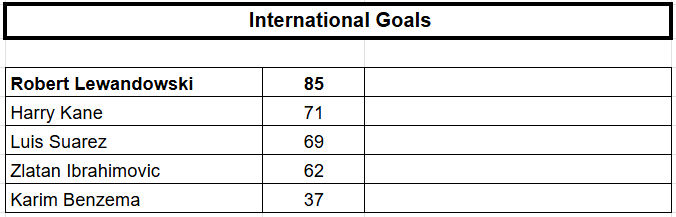
However, given the talent advantages that Ronaldo and Messi have had with Portugal and Argentina, Lewandowski’s contributions with Poland should not be overlooked. Prior to Lewy joining the Polish National Team, Poland had qualified for the Euros just once in its history. Since 2012, Poland has qualified for four consecutive Euros including its best ever finish (5th) in 2016. Lewandowski also helped Poland qualify for back-to-back World Cups in ‘18 and ‘22 for only the second time since 1986. His 85 international goals are the 7th most in history.
It’s doubtful that Lewandowski will be universally recognized as a top-3 or top-5 player of all-time due to factors outside of his control. He doesn’t have the same marketability or name recognition as many of the great players of his era. Poland is not a soccer powerhouse which means his status as a national icon is somewhat muted in a way that players like Messi, Ronaldo, and Mbappe will never be. The Bundesliga does not get the same attention as the Premier League or La Liga, nor does it have a 38-game schedule. However, the numbers, accolades, and the degree of difficulty are there to justify his standing as the greatest non-Messi, non-Ronaldo footballer of the last 50 years.
All statistics are through 6/28/2025.


Why is Barry Bonds the GOAT?
As much as an opinion can be a fact, it has always been a “fact” that Babe Ruth is the greatest baseball player of all-time. It’s an easy case to make. Nobody led the league in more categories more often than Ruth. His entire statistical archive is seemingly bolded or italicized, denoting league-leader status. He is the all-time leader in OPS+ and slugging percentage. He is the only player in baseball history to hit more than 600 home runs and hit at least .305—and he did it with 756 home runs and a .342 average! His dominance of the 1920s and 30s essentially forced baseball out of the dead-ball era. It would take thousands of words to list out all of the things Ruth did that nobody else did.
The Sultan of Swat is deserving of every alliterative appellation allocated to him and every hyperbolic half-truth that accompanies his name. Without Ruth, baseball would not be what it is today. He is a two-syllable history lesson of America’s pastime. DJ, kindly bring that record to a screeching halt. This is the “but” you were waiting for. Pee-Wee Herman said it first and said it best: “everyone I know has a big but” and this might be the biggest “but” of them all. Babe Ruth was the greatest player of his era, but he is not the greatest player of all-time. To evoke the moody train conductor from The Polar Express, baseball eras are not transferable. While Ruth’s astronomical statistical marks make him the king of his era, they cannot be taken at face value when comparing him to players from other eras. Ruth’s dominance of an 8-team league entirely devoid of black and Asian players, and largely devoid of Latino, Canadian, and Jewish players, requires loads of context. Additionally, Ruth played in a league that was hesitant to embrace the value of the home run, which made him stand out like a skyscraper in DC. It wasn’t that players couldn’t hit home runs, it’s that they literally didn’t realize they should be trying to. This, of course, wasn’t Ruth’s fault, but it sure made it easier to lead the league in home runs and slugging %. Every subsequent era after Ruth saw a league full of home-run chasing sluggers, meaning nobody after Ruth would have it quite as easy.
The only hitter in MLB history who rivals Ruth in dominance with respect to his era is Barry Bonds. DJ, cue the Death Star theme. Bonds won seven MVP Awards (and should have won two more in 1991 and 2000). That number is significant because, in the first 120 years of MLB, no two players combined to win 7 MVPs. That alone suggests that Bonds is, by far, the greatest hitter since 1931, when the MVP we recognize today was first handed out. Due to the fact that the MVP didn’t exist from 1915-1921, 1929 (AL), and 1930, and baseball rules prevented players from winning the award more than once from 1922-1928, Ruth’s official MVP count stands at one. With a little voodoo and some retro-prognostication, it is highly probable that Ruth would’ve come close to equaling Bonds’ seven MVPs. MVP voters have historically shown a penchant for spreading the award around to prevent one player from monopolizing it. So, it is unlikely that Ruth would’ve won the MVP every year that he was statistically the best player. In fact, we have evidence of how (un)likely voters at the time were to vote for him. In 1931, Ruth was clearly the best hitter in the American League, but finished 5th in the voting. Although the number of potential MVP awards Ruth could have won likely falls somewhere between 6-11, the outcome probably would’ve ended up on the lower end of that range.
Let’s just say for argument’s sake that Ruth would have won nine MVPs. During Ruth’s career, there were eight teams in the American League accounting for roughly 200 players. Over the course of Bonds’ career, there were an average of 15 teams in the National League accounting for roughly 375 players. That means that it was close to twice as difficult for Bonds to win an MVP than it was for Ruth. That makes Bonds’ seven MVPs more impressive than the nine MVPs we’ve graciously assumed for Ruth, and that doesn’t account for the fact that Ruth only had to compete against white players.
To continue the Ruth-Bonds comparison in earnest, we need to head to the “league leaders” pages at Baseball Reference, while continuing to account for league size and composition. A similar outcome to the MVP comparison unfolds when comparing Bonds and Ruth in two of the gold-standard measures of inter-era comparisons: WAR for Position Players and OPS+. Both Bonds and Ruth led the league in WAR for Position Players 11 times. Ruth led the league in OPS+ 12 times, and Bonds did it nine times. Given that it was almost twice as difficult for Bonds to lead the league in any category due to league size, it’s clear that his accomplishments in these two categories are more impressive than Ruth’s. Again, that only accounts for league size and not the significantly less competitive, very homogenized league that Ruth played in.
Both players led their respective leagues in OBP 10 times. Bonds led the league in walks 12 times, while Ruth did it 10 times. As lauded as Ruth is for his batting average, Bonds led the league in batting average twice, while Ruth did it once. Remember, Bonds simply being close to Ruth in these comparisons is a win given it was nearly twice as difficult for him to lead the league, but Bonds is actually beating Ruth in some of these comparisons. Ruth’s biggest advantage over Bonds comes in slugging percentage, where he led the league 13 times compared to Bonds’ seven. Even when it appears Ruth has a significant feather in his cap, the comparison results in a virtual stalemate. It was roughly 1.88 times as difficult for Bonds to lead the league in a category than it was for Ruth, and Ruth led the league in slugging percentage 1.86 times more often than Bonds. That’s about as close to a dead-heat as we’re going to find. Again, that only accounts for the size of the player pool and not the exponential increase in talent that flooded MLB after integration. It also doesn’t account for the fact that leading the league in slugging % was much easier for Ruth given the league was largely ignorant of the value of a home run. Bonds, on the other hand, played in the most competitive home run era in MLB history.
In order for Ruth to stake a claim as the greatest baseball player of all-time, he’d need to come close to doubling up Bonds in these comparisons, and it hasn’t even come close to playing out that way. Adjusting for league size and composition, Bonds’ achievements are more impressive than Ruth’s, and it’s hard to argue that it’s not by a significant margin. Ruth was an accomplished starting pitcher for the first five years of his career, which is certainly notable, but Bonds was an outstanding defensive player and an exceptional base-stealer, while Ruth was not. Let’s call that a wash.
There is no debating Ruth’s dominance or his impact on the sport. He ushered in an entirely new era of baseball by redefining what it meant to be a productive hitter. Bonds’ abrasiveness and PED use (not factored in the rankings and here’s why) make it virtually impossible that he will ever be universally—or even lightly—embraced as the greatest player of all-time. Heck, he can’t even get into the Hall of Fame. Most lists place Ruth as the greatest player of all-time, and most lists will continue to place Ruth as the greatest player of all-time. People aren’t necessarily interested in changing their minds on this, especially when the beneficiary would be Barry Bonds. The goal of this list is not to rank the most likable good players (here’s looking at you, Griffey); rather, it is to rank the greatest players of all-time using two overarching themes: dominance within their era and the competitiveness of their era. To go all Married… with Children, “you can’t have one without the other.”